
When maximizing boiler performance, the main hindrance can often be within the boiler backpasses. Over time, the economizer, tubular air heater (TAH), dust collector, and other backend equipment can erode, corrode, exhibit air in-leakage or have other performance issues that negatively impact the efficiency of the boiler. One common issue is corrosion within the TAH.
To maximize the rate of heat transfer while minimizing surface area, it has been a widespread practice to deploy counterflow TAH’s. In a counterflow arrangement, the coldest flue gas exchanges heat with the coldest air. Corrosion often occurs in these areas because the average tube temperature can regularly fall below the dew point for sulfur dioxide and sulfur trioxide (SO2 and SO3.) Jansen has seen many TAHs plagued with this systemic corrosion issue as the counterflow design arrangement is not able to accommodate for changing fuel quality or lower flue gas exit temperatures. Some mills mitigate the flue gas/air temperature difference by preheating the combustion air with a steam coil air heater (SCAH), but this leads to parasitic steam usage in the SCAH and reduces overall boiler efficiency.
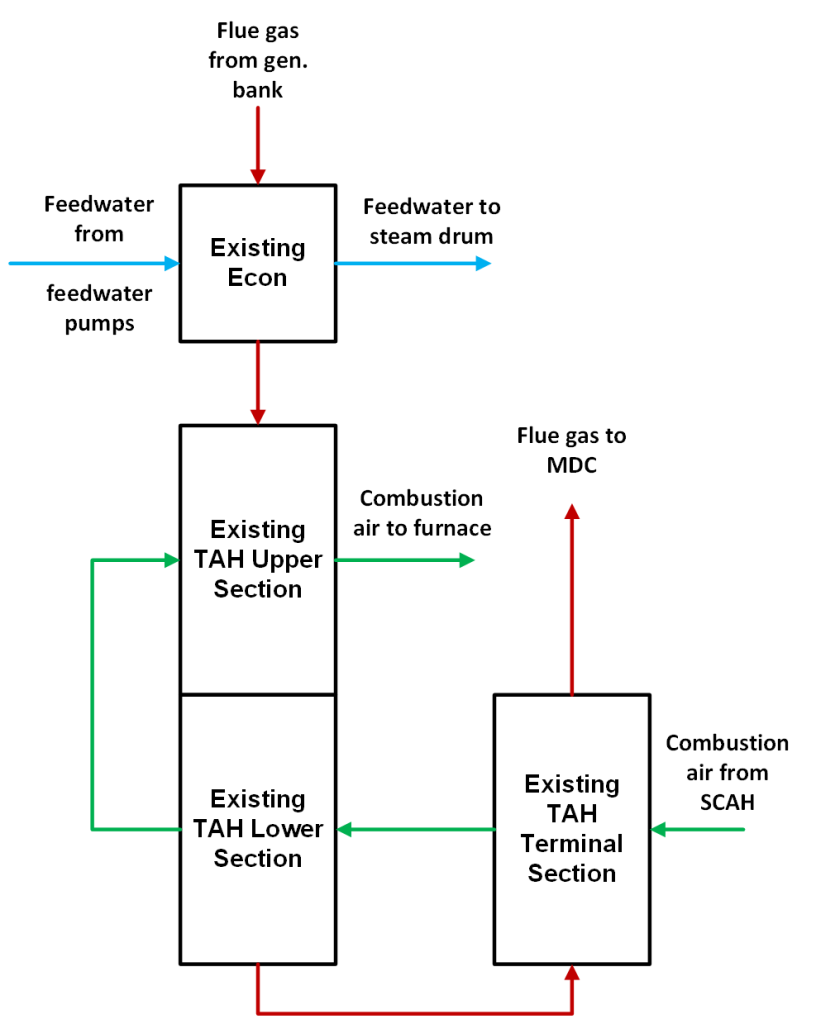
Having a combination of economizer and TAH is standard for most boilers, as these return a large amount of waste heat to the boiler through both the combustion air and the feedwater. Jansen has been exploring alternate configurations for a client whose boiler backpasses, including an economizer and TAH, are at end of life from a combination of erosion and corrosion. The TAH experiences erosion in the inlet tubes due to excessive flue gas velocities and corrosion in the cold end. A typical backend layout depicting an economizer and a counterflow TAH similar to our client’s arrangement is depicted in the schematic below.
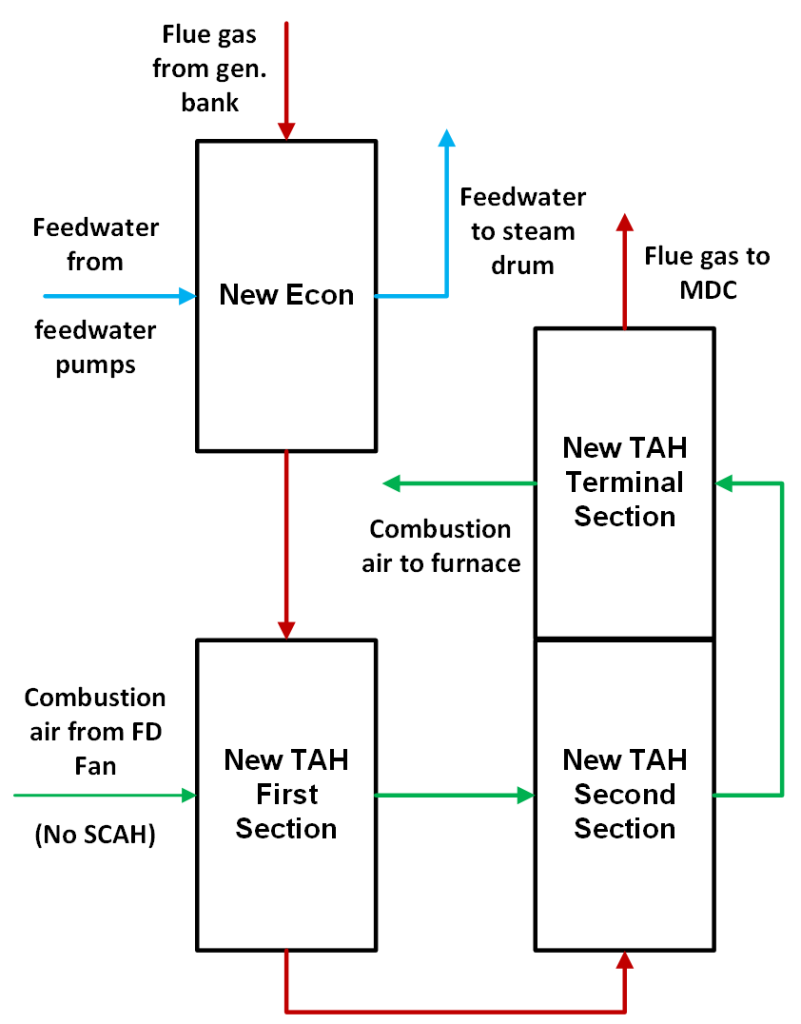
The first alternate configuration is shown in schematic below. By reversing the direction of combustion air flow in the TAH from counterflow to cocurrent flow and investing in a larger economizer, TAH tube metal temperatures rise by 50°F in the coldest end. This provides improved corrosion protection and the SCAH is no longer required. In addition, overall heat transfer from the flue gas remains identical to that of the original arrangement.
In general, not only are TAHs susceptible to cold end corrosion, they are also prone to pluggage and can erode when encountering high flue gas velocities and flue gas laden with particulate matter. Performance issues often arise as damaged and plugged TAH tubes result in increased gas side pressure drop and the introduction of air in-leakage into the gas stream, which puts more load on the induced draft fan. TAH inspections are time consuming and tube repairs can be difficult, if not impossible.
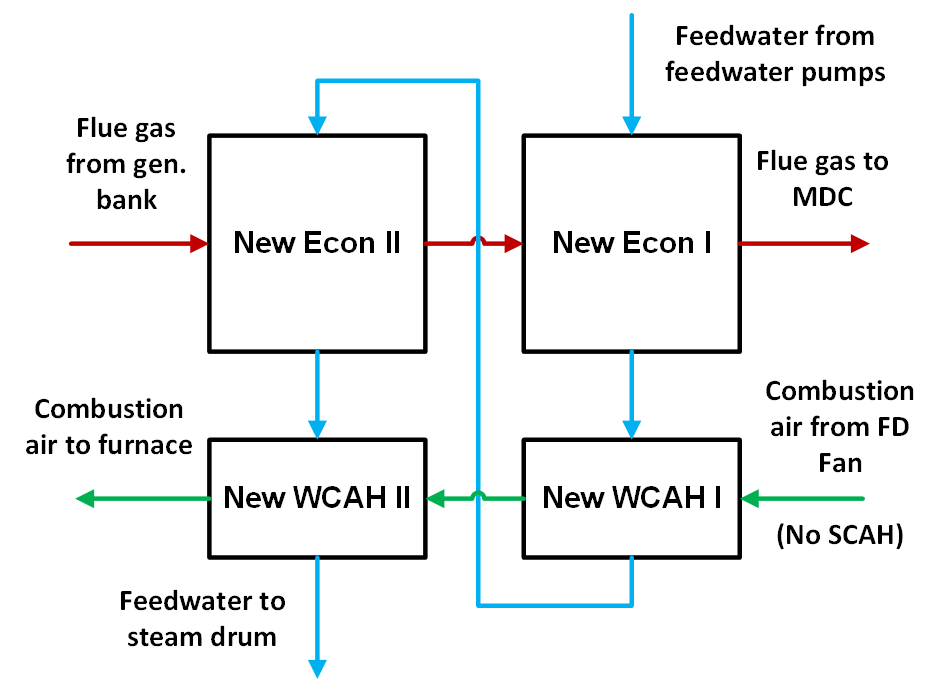
To provide a more robust design, a second alternate configuration is being considered. The design shown in the schematic below eliminates the TAH completely. In this arrangement, the existing economizer and TAH are replaced with two new large economizers. The feedwater exiting the economizers is then used to heat the combustion air using water coil air heaters (WCAHs.) This configuration allows the SCAH to be removed and results in heat transfer equivalent to the existing arrangement. The primary benefit of replacing the TAH with economizers is easier inspection efforts and reduced maintenance costs. In addition, economizer tubes are generally operating at higher temperatures which are well above the acid dew point as compared to TAH tubes. Therefore, economizers are less susceptible to acid dew corrosion.
As Jansen considers the longevity of equipment it is designing, it has three priorities: maximizing thermal efficiency, improving equipment lifespan, and reducing yearly equipment overhead. Jansen engineers are looking forward to providing clients with creative solutions to eliminating TAH cold end corrosion without compromising on efficiency. Click here to get in touch with us on this and other energy-saving solutions.
Author: Dannika Liddell – Process Engineer