
When examining boiler performance deficiencies, problems can often be traced to factors outside of the furnace, such as fuel quality. But sometimes the issue is the furnace itself. Jansen uses computational fluid dynamics (CFD) modeling to investigate performance improvements that can be realized through air system upgrades, furnace modifications, or both.
A furnace design concept that took hold in the second half of the 20th century was the addition of arches on the front and rear walls of the lower furnace. The intent was to separate the furnace into a lower gasification zone, in which fuel particles would dry and volatize, and an upper combustion zone where the volatile gases would then combust. Unfortunately, these arches also create a throat that greatly accelerates the flue gas flow. High flue gas velocities increase erosion within the furnace, particularly of the superheater tubes and the wall tubes that form the lower furnace arches. The accelerated flow also reduces the flue gas residence time in the upper furnace and contributes to the incomplete combustion of the volatile gases. The lower furnace arches can lead to high erosion-derived maintenance costs, high carbon monoxide (CO) emissions, incomplete char burnout, and flue gas temperature and velocity stratification.
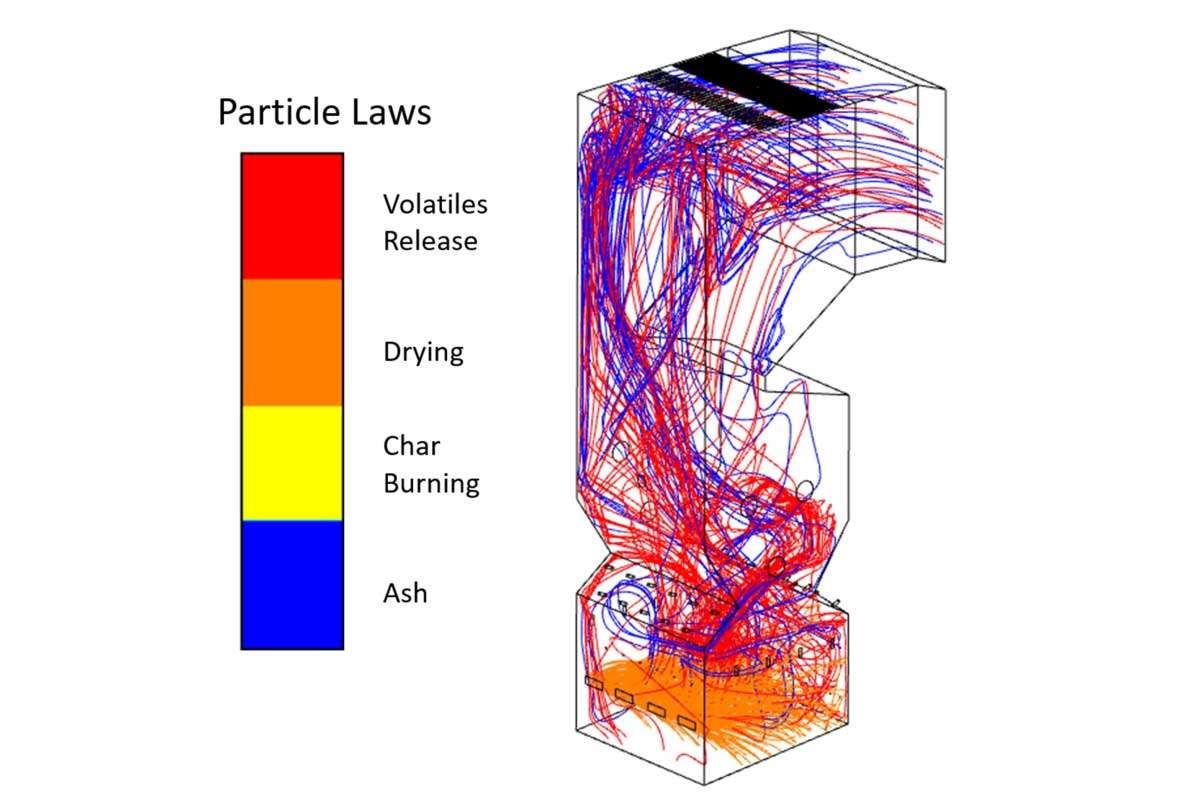
A recent CFD modeling project involved a biomass-fired power boiler with lower furnace arches. On the lefthand side of the video is an animation showing the fuel particle trajectories as they enter and exit the existing furnace configuration. The righthand video shows the furnace with an upgraded overfire air (OFA) system using Jansen’s patented High-energy Multi-range Combustion Air Nozzle™ in a sidewall interlaced configuration. These models track not only the particle trajectory, but also the chemistry and combustion phase of each particle. These variables are represented by the color coding of the fuel particles in the animation.
The existing configuration model illustrated how the throat in the lower furnace produces a central channel of incompletely combusted volatiles, resulting in areas of high CO concentration. The fuel particles do not spend sufficient time in the furnace to burn out prior to entering the superheater, where the combustion virtually extinguishes.
The model with the upgraded Jansen OFA system installed below the arches significantly increased the residence time of the particles in the furnace, and CO was predicted to be reduced by 14%. The OFA modification also decreased unburned char carryover by 19%, indicating an overall improvement in combustion performance. Jansen is currently working with our client in the design phase of the OFA system upgrade.
Overall, performance deficiencies due to lower furnace arches can be reduced with the addition of an upgraded OFA system, and there is the potential for further gains with the complete removal of the arches.
Jansen’s CFD modeling is performed entirely in-house as it has been for 30 years. Based on industry-standard software, we use our field measurements to confirm the base model and update our proprietary algorithms to produce the most accurate results possible.
CFD is indispensable as a tool to provide insights into furnace modifications that can lead to significant performance benefits. Click Here to contact us for more information on how our modeling capabilities can help improve your plant’s performance.
Authors: Zhaosheng Gao, PhD – Senior CFD Engineer; Morgan Silverman – Process Engineer; Samit Pethe – Manager, Process Technologies