
Jansen recently supported a client in South America in their desire to incinerate concentrated noncondensable gas (CNCG) in their recovery boiler. Our efforts used computational fluid dynamic (CFD) modeling capabilities to evaluate potential impacts on furnace combustion conditions. Of specific interest to the client was how incinerating CNCGs would alter carbon monoxide (CO), nitrogen oxides (NOX), and total reduced sulfur (TRS) emissions.
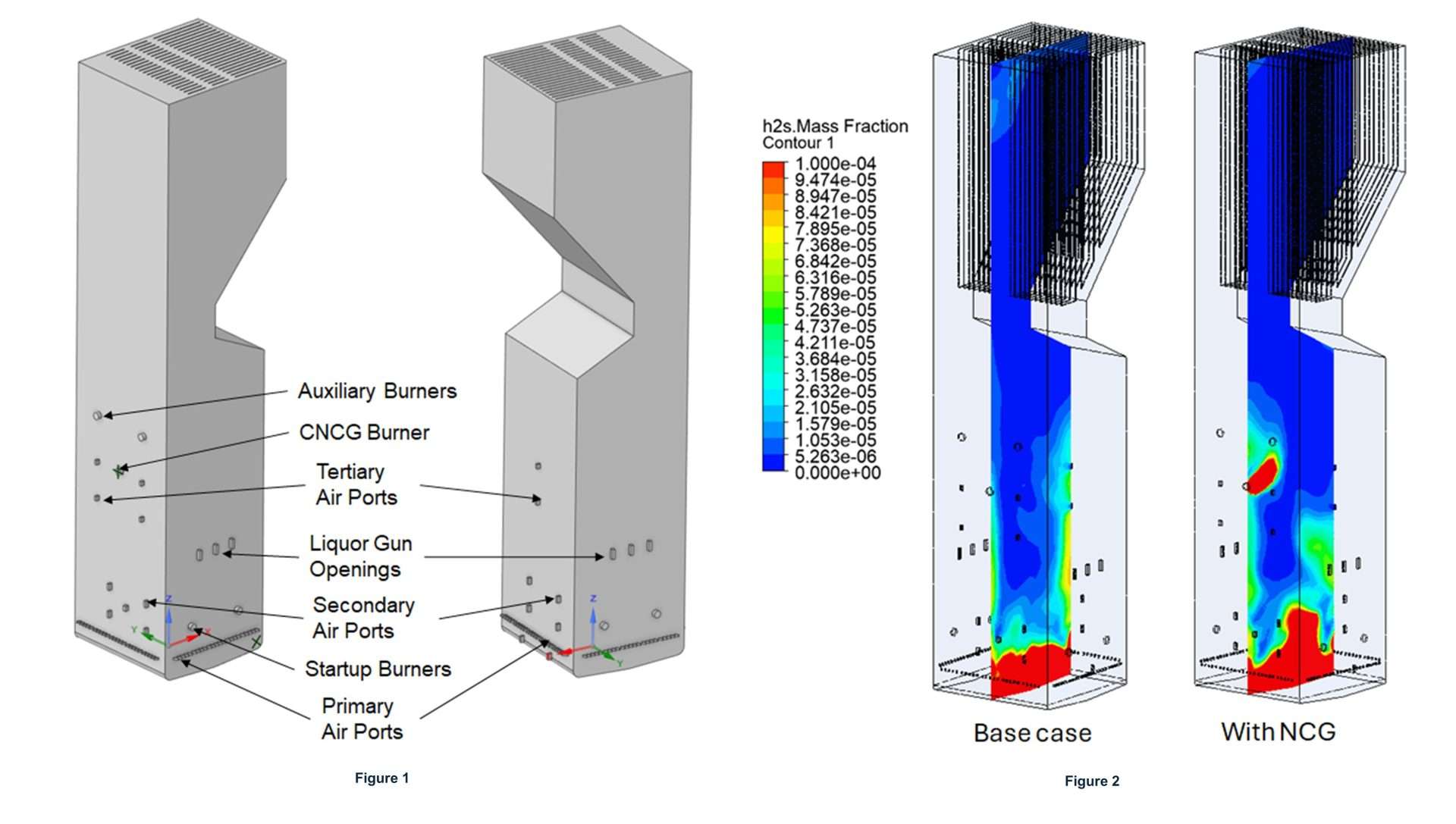
For this purpose, we conducted a complete engineering evaluation of the boiler. In the first phase, we built a custom thermodynamic model of the boiler. This model quantified the boiler’s performance, liquor firing rates, air flow and splits, and flue gas flow and temperature profiles. Outputs from the heat and mass balance model then served as inputs for a CFD model constructed of the furnace (Figure 1) for the second phase. CFD cases were simulated to validate the location of the CNCG burner so that it did not negatively impact furnace combustion conditions. Factors considered in this phase included optimal delivery location, species destruction criteria, corrosion concerns, and the impact on emissions. The modeling results (Figure 2) show TRS levels before and after the introduction of the NCGs.

Our CFD capabilities can also evaluate a range of conditions, as well as carryover. Additionally, due to the large volume of data generated from CFD models, Jansen has developed a post process algorithm for evaluating residence time criteria. Specifically, modeling data is used to track temperature profiles along stream and/or path lines as a function of time. This information confirms the time for which noncondensable gas (NCG) species are maintained above specific temperatures.
There has been a recent change of opinion and a readiness in North America to consider delivering and incinerating CNCGs in recovery boilers. Though motivations differ, the benefit of opting for the recovery boiler to incinerate the NCG provides a pathway for the capture and return of the sulfur contained in these streams back into the pulping process.
While Jansen can engineer a solution for destroying the gases, we specialize in the combustion side of the process. However, with the recent merger of Jansen and Lundburg, Jansen’s expertise with the combustion side seamlessly complements Lundburg’s expertise in design of collection, transport, and storage systems for NCGs. With our expanded capabilities, we can provide comprehensive turnkey solutions to our clients starting from NCG collection and delivery all the way to incineration in the boiler.
Our solutions are industry-leading and exceed the Black Liquor Boiler Advisory Committee (BLRBAC) recommended good practices for delivering and burning these gases in recovery boilers. Our systems provide additional interlocks and safety measures that prevent moisture from reaching the boiler, while ensuring the gases are thoroughly destroyed without negatively impacting combustion.
These projects are the first of many opportunities for us to leverage our combined expertise to provide a complete solution for our clients from start to finish. Click here to get more info on this and other combustion and pulp mill solutions.
Authors: Joe Klover, P.E. – Process Engineer (Jansen) and Benji Landron – Process Engineer (Lundberg)